By Alex Topilski, Founder
What Is IPTV Middleware?
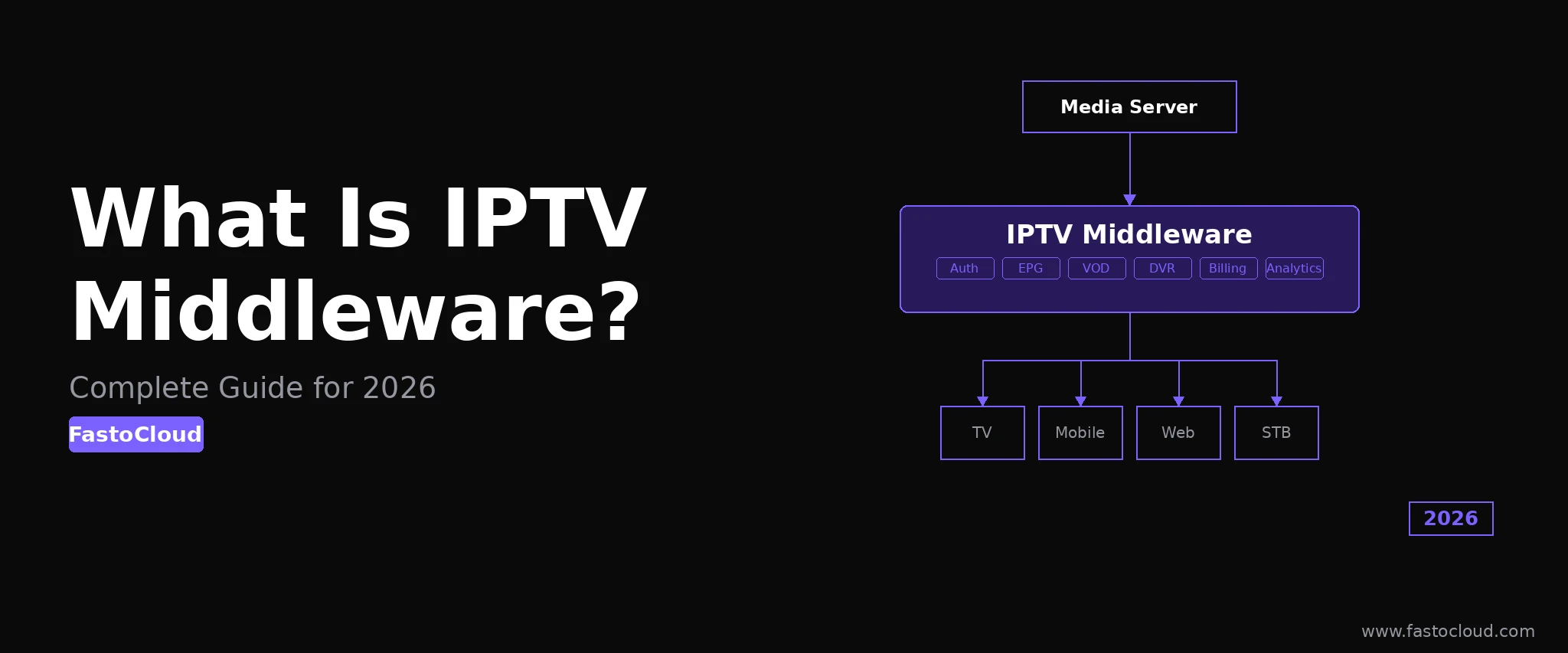
Roughly 85% of new IPTV service launches fail within the first year - and the most common technical reason is not poor video quality or network capacity. It is that operators underestimate what it takes to manage subscribers at scale once the streams are live. That is the problem IPTV middleware exists to solve. Middleware is the software layer that sits between your media server and your viewers' player apps. It handles subscriber authentication, content entitlement, EPG data, VOD catalog delivery, catch-up TV, device management, billing integration, geo-restriction, and analytics - all the business logic that transforms a collection of video streams into a commercially viable television service.
The term "middleware" comes from its position in the stack: it sits in the middle, between the backend infrastructure that produces and stores video and the frontend apps that display it to subscribers. A media server like FastoCloud Media Server can encode 200 simultaneous live channels with hardware acceleration and package them as HLS for delivery. But without middleware, there is no way to enforce that only paying subscribers can watch, that each account is limited to 2 concurrent streams, or that the British Premier League feed is geo-blocked outside licensed territories. Middleware enforces all of those constraints at the token and URL level, in real time, for every stream request.
Core Functions of IPTV Middleware
A production-grade IPTV middleware handles several distinct domains simultaneously. Understanding each function helps operators evaluate what they are buying and identify gaps in cheaper alternatives.
- Subscriber management - Account creation, login, password reset, subscription tier assignment, and suspension. Every subscriber gets a unique identity in the middleware database, and that identity is the source of truth for what they are allowed to watch.
- Content entitlement - The middleware maps each subscriber's package to a list of channels and VOD content they can access. When a player requests a stream URL, the middleware checks entitlement before issuing any token. Subscribers on a Basic plan see 80 channels; subscribers on a Premium plan see 300. The media server enforces this at the URL level.
- EPG (Electronic Programme Guide) - Live TV without an EPG is almost unsellable in consumer markets. Middleware aggregates EPG data from external XML feeds or manual entry and serves it to player apps in a standardized format, mapping programme schedules to each channel in real time.
- VOD catalog management - Storing metadata, artwork, descriptions, and stream URLs for on-demand content. Middleware handles category organization, search indexing, and per-subscriber rental or purchase records.
- Catch-up TV and DVR integration - Linking DVR recordings on the media server to time-shifted stream URLs, allowing subscribers to watch live channels up to 7 days after broadcast. The middleware generates authenticated catch-up URLs pointing to the correct recording segments.
- Device management - Tracking registered devices per account, enforcing concurrent stream limits (e.g., 1 stream on Basic, 4 streams on Family), and revoking device access when accounts are suspended or devices are reported stolen.
- Billing and payment integration - Subscription renewal, payment gateway hooks, trial period enforcement, and automated suspension on failed payments. Mature middleware includes webhook support for custom billing platforms.
- Analytics - Real-time dashboards showing active viewers per channel, subscriber growth, VOD play counts, and churn metrics. Without this data, operators cannot make informed decisions about content investment or capacity planning.
No operator should build these eight functions from scratch. The engineering cost of a reliable, secure subscriber management system alone exceeds 12 months of development time for a small team - and it will never be the differentiator of your service. The content and the viewing experience are. Middleware is infrastructure; buy it rather than build it.
IPTV Middleware Architecture: How the Pieces Connect
Understanding the data flow through an IPTV middleware stack prevents the most common architectural mistakes operators make during setup.
The flow starts at the encoder. A camera or broadcast source sends an RTMP or SRT stream to the media server. The media server transcodes the incoming signal into multiple HLS bitrate variants and stores them on disk or in an object store. Segment URLs are registered with the middleware so it knows where each channel's live content lives. The middleware does not receive video data directly - it only knows the URLs of segments produced by the media server.
When a subscriber opens a player app, the app contacts the middleware API to authenticate. If the credentials are valid, the middleware returns a session token and a list of channel entitlements. When the subscriber taps on a channel, the app sends the channel ID and the session token to the middleware. The middleware checks: Is the session valid? Does this subscriber's package include this channel? Has the device limit been exceeded? Is the subscriber's IP in a blocked territory? If all checks pass, the middleware generates a time-limited, signed stream URL pointing to the media server's HLS endpoint and returns it to the app. The app uses that URL to fetch segments. If the URL expires or is replayed from an unauthorized device, the media server returns a 403 and playback stops.
This architecture separates concerns cleanly. The media server focuses on video delivery at scale. The middleware focuses on access control. Each can be scaled independently. Adding 50,000 new subscribers is a middleware database and API capacity problem, not a media server problem. Handling a spike to 100,000 concurrent viewers is a media server and CDN capacity problem, not a middleware problem.
IPTV Middleware vs Headend: What Is the Difference?
The terms "headend" and "middleware" are sometimes used interchangeably by operators new to IPTV, but they refer to different parts of the stack. Understanding the distinction prevents purchasing decisions that leave gaps in your architecture.
| Component | Responsibility | Examples |
|---|---|---|
| Headend / Media Server | Ingest, transcode, package, and deliver video streams | FastoCloud Media Server, Wowza, Nimble Streamer |
| IPTV Middleware | Subscriber management, entitlement, EPG, VOD catalog, billing, analytics | CrocOTT, Xtream UI, Ministra, Stalker |
| Player App | Present video to the subscriber on their device | FastoCloud white-label apps, IPTV Smarters, TiviMate |
| CDN | Cache and distribute HLS segments to reduce origin load | FastoCloud PRO internal CDN, Cloudflare, AWS CloudFront |
A headend with no middleware is a streaming server anyone who knows the URL can access. A middleware with no headend is a subscriber database with nowhere to point subscribers. Both components are mandatory for a commercial IPTV service, and they must be integrated so the middleware can validate requests against real stream URLs from the media server. The Products & Solutions page shows how FastoCloud's components fit together as a full IPTV stack.
Authentication, Device Management, and Geo-Restriction
These three middleware functions generate the most operational questions from operators setting up their first commercial service. Each one has meaningful design choices that affect subscriber experience and operational security.
Authentication in modern IPTV middleware uses token-based sessions rather than username/password on every request. When a subscriber logs in, the middleware issues a session token with a configurable expiry - typically 24 hours to 7 days. The player app stores the token and presents it on every subsequent API call. This avoids sending credentials over the network repeatedly and lets the middleware revoke access instantly by invalidating a token. Magic link authentication (passwordless login via email) reduces subscriber support burden by eliminating the "forgot my password" call category entirely.
Device management is where operators lose the most revenue to credential sharing. A subscriber who shares their login with 5 friends costs the operator 4 subscription fees. Middleware enforces device limits at the session level: a Basic plan might allow 1 registered device and 1 concurrent stream; a Premium plan might allow 5 registered devices and 3 concurrent streams. When a new device registers, the middleware checks if the limit is reached. If it is, the subscriber must deregister an existing device before the new one is accepted. Operators running CrocOTT middleware can configure these limits per subscription package and audit device registration history per account.
Geo-restriction is enforced at the same token issuance point. When a player requests a stream URL, the middleware resolves the subscriber's IP address to a country or region using a MaxMind GeoIP database or equivalent. If the resolved location falls outside the channel's licensed territory, the middleware returns a 403 without issuing a stream URL. IP resolution has a known weakness: VPNs and proxy services can mask the real location. Middleware that combines IP geo-check with registered device fingerprinting catches most proxy bypass attempts.
How to Choose IPTV Middleware for Your Service
Not all middleware products fit every operator type. A regional cable operator migrating from satellite to IP has different requirements than a startup launching an AVOD sports service. The table above covers function; the questions below cover fit.
- Scale: How many active subscribers do you expect in year 1, year 3? Middleware that works at 500 subscribers may not have the database architecture to handle 50,000 without a full rewrite. Ask vendors about their largest single-tenant deployment.
- Self-hosted vs SaaS: SaaS middleware puts subscriber data in a third-party cloud. If you serve markets with data residency requirements (GDPR in Europe, PDPA in Thailand, LGPD in Brazil), self-hosted middleware is the only compliant option. Self-hosted also eliminates vendor lock-in - if the SaaS vendor raises prices or discontinues the product, you are stranded.
- API completeness: If you want custom player apps or a branded subscriber portal, the middleware must expose a full REST API covering authentication, entitlement, EPG, and VOD metadata. Middleware with a closed API forces you to use only the vendor's player, which limits your branding options.
- Pricing model: Per-subscriber pricing scales with your revenue. Fixed monthly licensing means overpaying at low subscriber counts and potentially underpaying at high counts. Per-subscriber models align incentives: the middleware vendor grows when you grow.
For operators who want a self-hosted, API-complete, per-subscriber-priced middleware with no upfront license fee, CrocOTT costs $0.20 per active subscriber per month. That means an operator with 500 active subscribers pays $100/month in middleware; an operator with 10,000 active subscribers pays $2,000/month. The pricing is fully transparent at fastocloud.com/pricing.html.
CrocOTT: FastoCloud's IPTV Middleware Platform
CrocOTT is the white-label OTT/IPTV middleware that FastoCloud ships alongside its media server. It handles the complete subscriber-facing stack: account registration, subscription management, content entitlement, EPG delivery, VOD catalog, catch-up TV, device binding, concurrent stream enforcement, geo-restriction, billing webhooks, and real-time analytics. The operator controls their own deployment on their own Linux server - no subscriber data leaves the operator's infrastructure.
CrocOTT integrates natively with FastoCloud Media Server. Stream URLs registered in the media server's management interface are automatically available in CrocOTT's channel list. Entitlement rules set in CrocOTT are enforced at the URL signing layer inside the media server, so there is no secondary authentication hop that adds latency. The integration covers live TV, VOD, and catch-up TV recording - all three content types share the same subscriber authentication context.
For player apps, CrocOTT ships with a REST API that supports iOS, Android, Android TV, Apple TV, Roku, Fire TV, Samsung Smart TV, LG Smart TV, and web. FastoCloud's white-label player apps are pre-integrated with the CrocOTT API on every supported platform. Operators can deploy a fully branded subscriber experience - custom logo, color scheme, app store listings under their own developer account - without writing a single line of backend code. The free trial includes access to both FastoCloud Media Server and CrocOTT middleware, so operators can test the complete ingest-to-subscriber pipeline before committing to a subscription.
The median time from initial deployment to first subscriber session on CrocOTT is under 24 hours for operators following the setup guide. Download the media server and connect it to CrocOTT to see the full stack in action.
Blog FastoCloud