What Is HLS?
HLS - HTTP Live Streaming. It is the adaptive bitrate protocol that powers the vast majority of video delivery on the internet today. Apple developed HLS in 2009 to solve a specific problem: getting video to play reliably on iPhones over cellular networks without requiring special server software or firewall rules. The solution was elegant. Break the stream into small files, serve them over plain HTTP, and let the player decide which quality to fetch based on available bandwidth.
That design decision turned out to be transformative. Because HLS runs over HTTP, it passes through every CDN, every firewall, and every proxy without modification. By 2026, HLS is the primary delivery format for live TV, sports broadcasts, IPTV services, OTT platforms, and VOD catalogs across every device category. If you operate a video streaming service, you are almost certainly delivering HLS to your viewers.
How HLS Works: Segments, Manifests, and ABR
HLS breaks a continuous video stream into a sequence of short media segments, each typically 2 to 10 seconds long. For live streams, an encoder like FastoCloud Media Server continuously produces these segments and writes them to disk. A playlist file with the .m3u8 extension is updated after each new segment is ready. The player fetches the playlist periodically, discovers the latest segment URLs, and downloads them in order for seamless playback.
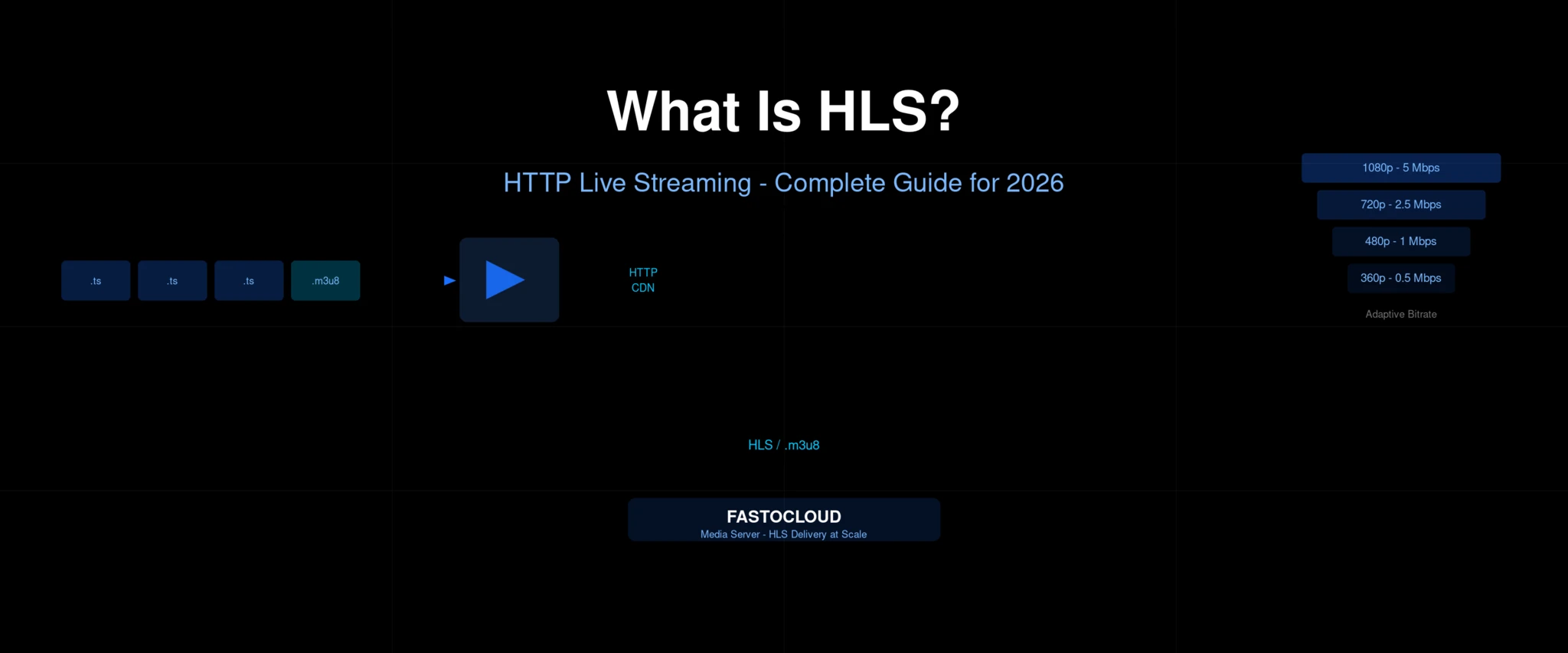
The real power of HLS comes from adaptive bitrate delivery. The server maintains multiple variant streams, each encoded at a different resolution and bitrate. A master playlist lists all available variants. The player measures its current download speed against each segment's download time and switches up or down to the appropriate quality tier as network conditions change. A standard ABR ladder for a professional service looks like this:
- 1080p at 4-6 Mbps - for broadband and strong Wi-Fi connections
- 720p at 2-3 Mbps - for average home broadband and 4G
- 480p at 800 Kbps - 1.2 Mbps - for weaker 4G and congested Wi-Fi
- 360p at 400-600 Kbps - for 3G and low-signal mobile connections
FastoCloud Media Server generates multi-bitrate HLS ladders automatically using hardware-accelerated encoding. Nvidia NVENC and Intel Quick Sync Video dramatically reduce the CPU load compared to software encoding, letting a single server handle dozens of simultaneous live channels at multiple quality levels.
HLS vs DASH: Which Protocol Should You Use?
DASH (Dynamic Adaptive Streaming over HTTP) is HLS's main alternative. Both protocols segment video and serve it over HTTP with adaptive bitrate switching. The technical differences come down to format and device support.
HLS uses .m3u8 playlists and either .ts transport stream segments or fragmented MP4 (fMP4) segments. DASH uses .mpd manifests and MP4 segments. HLS has native playback support in Safari and all iOS devices, without any JavaScript player library. DASH has broader native support on Android and desktop Chrome, though JavaScript players like hls.js and dash.js close the gap on web.
For DRM-protected content, the protocols diverge further. HLS uses Apple's FairPlay DRM, which only works on Apple devices. DASH uses Widevine (Google) and PlayReady (Microsoft), covering Android, Chrome, Edge, and most smart TVs. Serving a licensed content library to every device requires both protocols.
Most professional operators run both. FastoCloud Media Server outputs HLS and DASH from the same encoding pipeline, so you package once and let the player or middleware select the appropriate format per device.
Standard HLS vs Low-Latency HLS
Standard HLS carries a latency of 15 to 30 seconds from camera to viewer. That is acceptable for VOD and pre-produced live events, but it rules out use cases where real-time reaction matters: live sports, betting, auctions, interactive broadcasts, and breaking news.
Low-Latency HLS (LL-HLS), standardized by Apple in 2019, reduces end-to-end latency to 2 to 4 seconds using three mechanisms. First, partial segments are served before the full segment finishes writing, giving the player something to play immediately. Second, preload hints tell the player the URL of the next partial segment before it exists, eliminating a round-trip. Third, blocking playlist reload holds the HTTP response open on the server until the next segment is ready, replacing constant polling with a push-style notification.
The result is latency comparable to WebRTC for most use cases, without the complexity of peer-to-peer infrastructure. LL-HLS scales with standard HTTP CDNs, making it the right choice for live sports and news delivery at scale. FastoCloud PRO supports LL-HLS output alongside standard HLS and DASH.
HLS for Live Streaming vs VOD
HLS behaves differently depending on whether the content is live or pre-recorded.
For live streaming, the .m3u8 playlist is a sliding window. It typically contains the last 3 to 5 segments and is tagged with #EXT-X-LIVE. The player polls the playlist on a timer equal to the target segment duration. Older segments fall off the window and can be deleted from disk if you are not recording for DVR. FastoCloud handles continuous live HLS output, segment rotation, and DVR storage simultaneously.
For VOD, the playlist is static and lists every segment from start to finish. It is tagged with #EXT-X-ENDLIST. The player can seek to any point by jumping to the segment that covers that timestamp. VOD HLS assets are typically generated from a transcoding job after the source file is uploaded. FastoCloud Media Server processes VOD files with GPU-accelerated transcoding, producing a complete multi-bitrate HLS package ready for delivery.
HLS Segment Duration and CDN Considerations
Segment duration affects latency, buffering behavior, and CDN efficiency. For live streams, 4 to 6 second segments give a reasonable balance. Shorter segments reduce latency but produce more HTTP requests per viewer, increasing CDN origin load. Longer segments improve CDN cache hit rates and reduce request volume, but add latency.
CDN caching is critical for HLS at scale. Media segments are static files that can be cached aggressively: a 4-second segment served to 10,000 concurrent viewers from CDN cache costs almost nothing at the origin. Only the manifest file must be fetched fresh on every poll, since it updates with each new segment. Proper cache-control headers on segments (long TTL) versus manifests (no-cache or short TTL) are essential for cost-efficient delivery.
FastoCloud PRO includes a built-in edge caching layer and load balancer, distributing HLS segment delivery across multiple nodes without requiring a third-party CDN contract. As viewer counts grow, you add nodes to the cluster and FastoCloud distributes segment delivery automatically.
Delivering HLS at Scale with FastoCloud
Running HLS in production for an IPTV or OTT service involves more than just encoding. Subscriber authentication, geo-restrictions, DRM, EPG data, DVR storage, and multi-platform client apps all need to work together with the HLS delivery pipeline.
CrocOTT, FastoCloud's white-label OTT/IPTV middleware, sits between the media server and the viewer. It manages subscriber accounts, validates entitlements before issuing HLS stream URLs, enforces geo-blocking and device limits, and serves EPG data to the player. At $0.20 per active subscriber per month, CrocOTT gives independent operators enterprise-grade middleware at a price that works at any scale.
FastoCloud also provides white-label player apps for iOS, Android, Android TV, Apple TV, Samsung Smart TV, LG Smart TV, Fire TV, Roku, and web. Each app is pre-integrated with CrocOTT's backend and handles HLS playback, ABR switching, and DRM decryption natively on every supported platform.
Start your free trial to see FastoCloud's HLS delivery pipeline in action, or review pricing plans to find the right configuration for your streaming service.
Blog FastoCloud