What Is Restreaming and Why It Matters
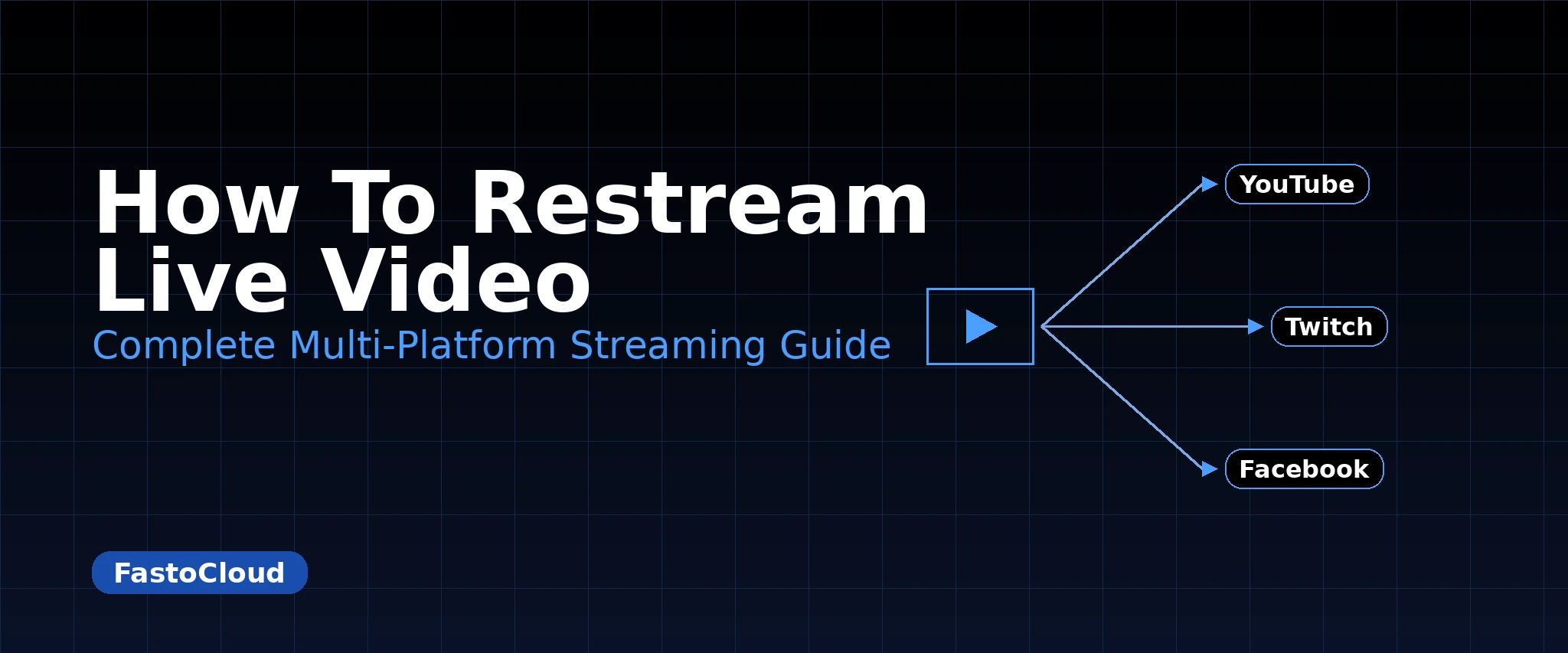
Restreaming means taking a single live video source. A camera, encoder, or software stream. And distributing it simultaneously to multiple destinations or audience segments. Instead of going live on YouTube alone, a broadcaster using restreaming sends the same stream to YouTube, Twitch, Facebook Live, and their own OTT platform at the same time, from a single ingest point.
The business case is straightforward: your audience is fragmented across platforms, and being present on only one means missing everyone else. Professional sports leagues, news broadcasters, corporate event producers, and IPTV operators all rely on restreaming to maximize reach without proportionally increasing production costs. This guide covers every technical layer you need to understand. Ingest, transcoding, protocol selection, multi-destination delivery, and platform management. Along with how FastoCloud Media Server handles all of it from one interface.
How Restreaming Works: The Technical Pipeline
A restreaming pipeline has four stages:
- Ingest - your encoder sends one stream (via RTMP or SRT) to your restreaming server
- Processing - the server optionally transcodes or re-packages the stream, adjusting codec, bitrate, or resolution as needed for each output destination
- Output routing - the server pushes the processed stream to each target simultaneously: social platforms via RTMP push, your own CDN via HLS/DASH output, WebRTC endpoints for interactive viewers
- Monitoring - stream health, bitrate stability, and output connectivity are tracked in real time
The key architectural decision is where the restreaming server sits. Cloud-based restreaming services handle this for you but introduce per-stream fees, latency you cannot control, and a hard dependency on a vendor's infrastructure. A self-hosted restreaming server. Such as FastoCloud Media Server - runs on your own Linux hardware, gives you full control over output destinations, and costs a flat monthly fee regardless of how many streams you run or how many simultaneous viewers you serve.
Ingest Protocols: RTMP vs SRT
The two dominant ingest protocols for live video are RTMP and SRT, and choosing between them affects latency, reliability, and encoder compatibility.
RTMP (Real-Time Messaging Protocol) is the legacy standard. Every software encoder. OBS, vMix, Wirecast, XSplit. Sends RTMP by default, and virtually every hardware encoder supports it. Latency from encoder to server is typically 2-5 seconds. RTMP is unencrypted by default (RTMPS adds TLS) and handles packet loss poorly over unstable connections, making it a poor choice for ingest over congested public internet or satellite links.
SRT (Secure Reliable Transport) is the modern alternative. It was designed specifically for video transport over unreliable networks. SRT uses ARQ (Automatic Repeat Request) to recover lost packets, supports encryption natively, and offers configurable latency (typically 500ms-2s). For production ingest over public internet, SRT is clearly superior. FastoCloud Media Server accepts both RTMP and SRT ingest, so you can choose per-stream based on the encoder and network path available.
Transcoding for Multi-Destination Output
Different output destinations have different requirements. YouTube recommends 1080p at 4-8 Mbps; Twitch caps ingested streams at 8 Mbps and recommends 720p for most streamers; your own OTT platform may need an adaptive bitrate (ABR) ladder at multiple resolutions simultaneously. A restreaming server that can only pass through the original stream without transcoding is limited to destinations that accept that exact format.
FastoCloud Media Server includes hardware-accelerated transcoding (Nvidia GPU and Intel QSV), which means you can ingest a single high-bitrate source and output:
- A 1080p RTMP stream pushed to YouTube
- A 720p RTMP stream pushed to Twitch
- A multi-bitrate HLS output (1080p, 720p, 480p, 360p) for your own OTT audience with adaptive quality
- A WebRTC stream for sub-second latency interactive viewing
All from the same single encoder source, processed in real time. Hardware acceleration keeps transcoding latency low (typically under 500ms added to the pipeline) and allows a single mid-range server to handle many concurrent streams without CPU bottlenecks.
Multi-Destination RTMP Push
Sending your stream to YouTube, Twitch, Facebook Live, and similar platforms uses RTMP push: your restreaming server initiates an outbound RTMP connection to each platform's ingest endpoint using the stream key that platform provides. This is the mechanism behind every "multistream" feature you see in software like OBS (via third-party plugins) or dedicated restreaming services.
When you handle restreaming on your own server, you configure each destination independently. For each output in FastoCloud Media Server, you set:
- The destination RTMP URL (e.g.,
rtmp://a.rtmp.youtube.com/live2/) - The stream key provided by the platform
- Optional bitrate and resolution if you want per-destination transcoding
FastoCloud supports an unlimited number of simultaneous RTMP push outputs per stream. You can reach ten platforms at once just as easily as two. There are no per-destination fees and no artificial limits imposed by the software.
HLS and DASH for Your Own OTT Audience
For viewers on your own platform. Web players, mobile apps, smart TVs. RTMP push is not appropriate. These audiences receive HLS (HTTP Live Streaming) or DASH (Dynamic Adaptive Streaming over HTTP) delivered through your CDN or FastoCloud's built-in CDN and load balancer.
HLS works by segmenting the video into small chunks (typically 2-6 seconds each) wrapped in a playlist file (.m3u8). Players download the playlist repeatedly and fetch new segments as they appear. Adaptive bitrate HLS allows the player to switch between quality renditions in real time depending on the viewer's available bandwidth. A critical feature for OTT audiences on heterogeneous networks.
FastoCloud generates HLS and DASH output simultaneously from the same transcoded source, so you can serve your OTT audience with adaptive streaming while simultaneously pushing to social platforms. The built-in CDN distributes HLS/DASH segments to viewers at scale, handling thousands of concurrent connections without requiring a separate CDN service for moderate audience sizes.
WebRTC for Interactive and Low-Latency Use Cases
Standard HLS and DASH delivery carries 4-30 seconds of end-to-end latency depending on segment duration and CDN caching behavior. For interactive formats. Live auctions, Q&A sessions, sports betting with live odds, viewer-controlled cameras, or any use case where the audience needs to react in near real-time. This latency is unacceptable.
WebRTC reduces end-to-end latency to 100-500ms by bypassing HTTP-based segment delivery entirely and using peer-to-peer or server-relayed media transport over UDP. FastoCloud Media Server PRO includes WebRTC output alongside HLS and DASH, letting you serve a low-latency interactive audience and a broadcast-scale HLS audience from the same live source simultaneously. This is particularly useful for IPTV operators who want to offer an interactive tier to premium subscribers without running a separate infrastructure stack.
Monitoring and Managing Restream Health
A restreaming setup that distributes to six platforms simultaneously has six potential failure points in addition to the ingest connection. Effective monitoring tracks each output independently:
- Ingest bitrate. Drops indicate upstream encoder or network problems
- Per-output connection status. If the YouTube RTMP connection drops, you want to know within seconds, not when a viewer notices
- Output bitrate match. The outgoing bitrate should match the configured target; deviations suggest transcoding or network issues on the output path
- Segment generation rate for HLS/DASH - new segments should appear on schedule; delays cause viewer buffering
FastoCloud's admin dashboard displays stream health, bitrate graphs, and connection status for all inputs and outputs in real time. Probe streams, available in the PRO edition, automatically verify that each output is healthy by checking the stream from the outside, not just monitoring the internal process.
Building a Restreaming Infrastructure With FastoCloud
A complete self-hosted restreaming setup with FastoCloud works as follows: your encoder sends one RTMP or SRT stream to your FastoCloud Media Server. The server transcodes it as needed and simultaneously pushes RTMP streams to your chosen social platforms, serves HLS/DASH to your OTT audience via the built-in CDN, and optionally outputs WebRTC for low-latency viewers. All of this is configured through a single admin interface, without piecing together separate tools for each function.
The FastoCloud Media Server Community edition ($25/month) covers restreaming and encoding for operators who need straightforward multi-destination RTMP push. The PRO edition ($50/month) adds WebRTC output, the internal CDN and load balancer, and probe streams for production-grade health monitoring. For operators running an IPTV or OTT service alongside restreaming, CrocOTT middleware integrates with the media server to manage subscriber access, billing, EPG, catch-up TV, and white-label apps across Android, iOS, Smart TV, and web. All self-hosted on your own infrastructure.
Ready to take control of your restreaming pipeline? Start a free trial or review FastoCloud pricing to find the right edition for your multi-platform streaming requirements.
Blog FastoCloud